
Executive Summary
Revenue Cycle Management (RCM) is the intricate administrative and clinical intersection that governs how a healthcare provider gets paid. From the moment a patient schedules an appointment to the moment their account balance reads zero, RCM dictates the financial viability of the practice. With denial rates rising by over 20% in the last five years and shifting payer algorithms increasing the complexity of clean claims, modern medical practices must transition from a reactive "medical billing" mindset to a proactive, analytics-driven RCM strategy. This guide unpacks the entire RCM workflow, highlights critical revenue leakage points, and provides actionable frameworks to optimize cash flow.
Key Takeaways
- RCM is End-to-End: It begins before the patient arrives (eligibility) and ends long after they leave (collections and denial appeals).
- Front-End Focus Saves Back-End Pain: Over 80% of claim denials originate from front-office errors (e.g., incorrect insurance verification).
- Denial Management is the Profit Center: Failing to systematically work and appeal denied claims leaves up to 15% of a practice's gross revenue permanently on the table.
- Metrics Matter: You cannot improve what you do not measure. Tracking KPIs like Clean Claim Rate, Days in A/R, and Net Collection Ratio is mandatory for survival.
- Outsourcing is a Strategic Lever: Many New York and New Jersey practices are abandoning in-house billing models to leverage the specialized expertise, technology, and scale of dedicated RCM partners.
Table of Contents
- What Exactly is Revenue Cycle Management?
- Medical Billing vs. RCM: Understanding the Difference
- The Step-by-Step RCM Workflow
- Financial Impact Discussions: Where Practices Bleed Money
- Compliance Considerations in the Revenue Cycle
- Case Study: Rescuing a Specialty Clinic from A/R Ruin
- Best Practices and Common Mistakes
- A Step-by-Step Framework for RCM Optimization
- Conclusion
1. What Exactly is Revenue Cycle Management in Healthcare?
In the simplest terms, Revenue Cycle Management (RCM) is the financial process that healthcare facilities use to track patient care episodes from registration and appointment scheduling to the final payment of a balance.
Unlike standard retail or corporate billing, medical billing involves a complex triad of stakeholders:
- The Provider: The physician, hospital, or specialty clinic rendering the medical service.
- The Patient: The individual receiving the care, who carries an increasing burden of the cost via high deductibles.
- The Payer: The insurance entity (Medicare, Medicaid, or commercial payers like Aetna, Cigna, or BlueCross BlueShield) responsible for reimbursing the provider based on highly specific, constantly shifting contractual rules.
Because payers design their systems to scrutinize and deny claims that do not perfectly align with their coding guidelines and medical necessity rules, capturing revenue in healthcare is an ongoing battle. RCM is the strategic framework used to win that battle.
2. Medical Billing vs. RCM: Understanding the Difference
A common mistake made by many independent practices and clinic administrators is conflating "medical billing" with "revenue cycle management." While they are related, they are not synonymous.
Medical Billing is a reactive, transactional task. It involves taking the codes generated from a patient visit, putting them on a CMS-1500 or UB-04 form, submitting them to a clearinghouse, and sending a bill to the patient for the remainder.
Revenue Cycle Management is a proactive, holistic strategy. It starts days or weeks before the patient arrives. It encompasses the verification of their benefits, the authorization of their procedure, the clinical documentation integrity, the certified coding process, the rigorous denial management strategy, and the analytical reporting of financial KPIs.
If you treat your finances like "billing," you will inevitably suffer high denial rates and bloated Accounts Receivable (A/R). If you treat your finances like "RCM," you protect your revenue proactively.
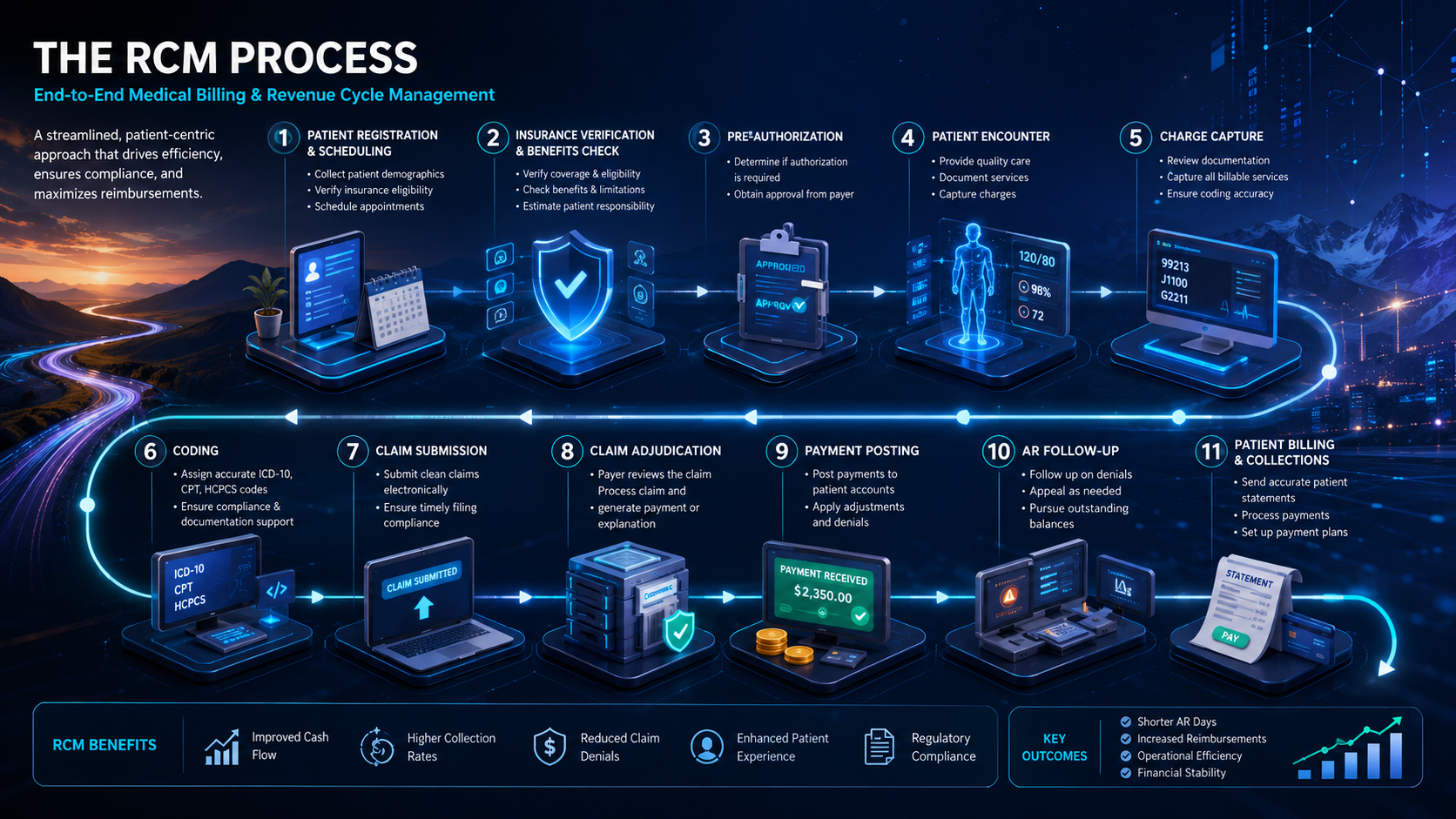
3. The Step-by-Step RCM Workflow
To master the revenue cycle, one must master each of its chronological phases. A failure in Step 1 will inevitably cause a catastrophic failure in Step 5.
Phase 1: Pre-Registration and Scheduling
The cycle begins when the patient contacts the office. Front-desk personnel capture demographic data, insurance information, and the reason for the visit. This data establishes the patient's account.
Phase 2: Eligibility and Benefits Verification
This is arguably the most critical step in the entire process. Before the patient arrives, the practice must verify that their insurance policy is active, confirm their copay and deductible status, and determine if the specific service requires Prior Authorization.
Phase 3: Charge Capture and Clinical Documentation
During and immediately after the encounter, the physician documents the clinical narrative in the EMR. This documentation must support the medical necessity of the services rendered.
Phase 4: Medical Coding
Certified medical coders (typically credentialed by AAPC or AHIMA) translate the physician's clinical notes into standardized alphanumeric codes. They use:
- ICD-10-CM Codes: To describe the patient's diagnosis.
- CPT and HCPCS Codes: To describe the treatments, procedures, and equipment utilized.
Accuracy here is non-negotiable. Undercoding leaves money on the table; overcoding invites federal audits and severe compliance penalties.
Phase 5: Claim Scrubbing and Submission
The codes and patient data are assembled into a claim. Top-tier RCM systems run these claims through a "scrubber"—software that checks for missing modifiers, mismatched demographics, or coding conflicts against millions of payer rules. Once scrubbed, the "Clean Claim" is securely transmitted via a clearinghouse to the payer.
Phase 6: Payment Posting and Remittance
The payer adjudicates the claim and issues an Electronic Remittance Advice (ERA) detailing what was paid, what was denied, and what is applied to the patient's deductible. Payment posting involves accurately applying these funds to the patient's ledger.
Phase 7: Denial Management and A/R Follow-Up
If a claim is denied, the RCM team must act swiftly. They investigate the root cause, correct the data, and submit an appeal. Simultaneously, they work the Accounts Receivable aging report, calling payers to push stalled claims through the system.
Phase 8: Patient Collections
Once the insurance has paid its portion, the remaining balance is billed to the patient. With the rise of High-Deductible Health Plans (HDHPs), patient responsibility is a massive chunk of practice revenue. Effective RCM relies on clear patient statements, online payment portals, and compassionate but firm collection policies.
4. Financial Impact Discussions: Where Practices Bleed Money
Why is RCM so vital? Because the financial margins for independent practices and specialty clinics are shrinking. Operational costs, inflation, and staffing wages are rising, while Medicare and commercial reimbursement rates are remaining stagnant or facing cuts.
When you analyze the financial impact of poor RCM, the numbers are staggering:
- The Cost of Denials: Industry data shows that the average cost to rework a single denied claim is $25 to $30. If your practice receives 500 denials a month, that is $15,000 per month in administrative rework costs alone—not counting the actual revenue lost if the claims are never paid.
- Aging A/R Depreciation: Medical debt depreciates faster than almost any other asset. The probability of collecting a claim drops to roughly 70% after 60 days. After 120 days, the probability of collection plummets to roughly 10%. If your A/R bucket over 90 days is bloated, that is effectively "ghost revenue" that will likely become bad debt.
- Patient Collection Friction: Providers historically collect only about 15% to 20% of patient balances once the patient leaves the clinic. Implementing upfront collection protocols at the front desk is a million-dollar operational shift for multi-provider clinics.
5. Compliance Considerations in the Revenue Cycle
Optimizing revenue cannot come at the expense of compliance. The Office of Inspector General (OIG), CMS, and commercial payers employ aggressive auditing mechanisms to identify fraud, waste, and abuse.
A robust RCM strategy incorporates compliance at every level:
- Upcoding and Unbundling: Routinely billing for a higher-level Evaluation and Management (E/M) visit than the documentation supports is a severe compliance violation. RCM requires routine, randomized internal audits of coding accuracy.
- HIPAA Compliance: From clearinghouse transmissions to patient statements, all electronic Protected Health Information (ePHI) must be encrypted and handled according to stringent HIPAA Security Rules.
- Credentialing Hurdles: If a provider is not properly credentialed and enrolled with a payer, the payer will not reimburse their services. Provider credentialing is a foundational compliance and RCM step that requires constant monitoring to prevent expirations.
6. Case Study: Rescuing a Specialty Clinic from A/R Ruin
The Scenario
A thriving 5-provider multi-specialty clinic in New Jersey was seeing 120 patients a day, yet the owners were constantly struggling to make payroll. Their in-house billing team was overwhelmed, and their A/R over 120 days had ballooned to $1.2 million.
The Diagnosis
An RCM audit revealed a catastrophic failure at Phase 2 (Eligibility) and Phase 7 (Denial Management). The front desk was not verifying benefits, leading to a 22% initial denial rate. The in-house billers, overwhelmed by the volume of new claims, simply ignored the denials. The claims aged out past the 180-day timely filing limits and expired.
The Axon Claim Intervention
- Front-End Workflow Overhaul: Implemented mandatory 48-hour advanced eligibility verification.
- A/R SWAT Team: Deployed a dedicated A/R recovery team to aggressively appeal the $1.2M backlog before timely filing limits permanently closed the window.
- Result: Within 90 days, the denial rate dropped from 22% to 4%. Axon Claim recovered $450,000 of the "lost" aging A/R, stabilizing the clinic's cash flow and allowing them to hire two new physician assistants.
7. Best Practices & Common Mistakes
Common Mistakes Providers Make
- Relying on "Auto-Post": Trusting the EMR to automatically post ERA payments without human reconciliation leads to invisible write-offs and ignored denials.
- Ignoring Small Balance Denials: A $25 denial does not seem worth fighting, but if it happens 200 times a month, you are losing $60,000 a year. Systematic denial management requires fighting for every dollar.
- Using Outdated Fee Schedules: If you are not updating your chargemaster and fee schedules annually to reflect Medicare and commercial payer increases, you are billing below allowable rates and sacrificing pure profit.
Elite RCM Best Practices
- Target a >95% Clean Claim Rate: Utilize advanced claim scrubbing software to catch demographic and coding errors before they hit the clearinghouse.
- Implement Card-on-File Policies: Securely keeping a patient's credit card on file allows you to automatically charge small balances post-adjudication, virtually eliminating patient A/R and statement mailing costs.
- Outsource Strategically: Independent practices in competitive markets (like NY healthcare providers and NJ specialty clinics) are increasingly outsourcing their RCM to specialized firms. This eliminates staffing overhead, ensures compliance, and puts a team of AAPC-certified experts in their corner.
8. A Step-by-Step Framework for RCM Optimization
If you are a Practice Owner, Clinic Administrator, or Revenue Cycle Director looking to fix your billing process today, follow this immediate action plan:
Step 1: Pull the Aging A/R Report
Run a report today. Look at the ">90 Days" and ">120 Days" columns. If these columns represent more than 15-20% of your total A/R, you have a critical operational failure.
Step 2: Audit Your Top 5 Denial Reasons
Identify exactly why your claims are bouncing back. Is it CO-11 (Diagnosis inconsistent with procedure)? Is it CO-16 (Lacking information)? Is it CO-22 (Coordination of benefits)? Find the top 5 reasons, and train your staff specifically on how to fix them.
Step 3: Mandate Upfront Collections
Institute a non-negotiable policy at the front desk: Copays and past-due balances must be collected before the patient sees the provider.
Step 4: Evaluate Outsourcing ROI
Calculate the true cost of your in-house billers (Salary + Benefits + Software + The Revenue Lost to Ignored Denials). Compare that to the flat performance-fee of a premium RCM partner. Often, the outsourced firm pays for itself entirely by recovering the revenue your current team is ignoring.
9. Conclusion
Revenue Cycle Management in healthcare is a highly specialized, unforgiving discipline. The days of submitting a claim and simply hoping it gets paid are over. Today, capturing revenue requires surgical precision, relentless follow-up, deep coding expertise, and robust technological infrastructure.
By understanding the end-to-end RCM process, eliminating front-end errors, and aggressively pursuing denials, medical practices can stabilize their cash flow, reduce administrative burnout, and return their focus to what truly matters: delivering exceptional patient care.
Axon Claim LLC – RCM Experts
We are a premium Revenue Cycle Management partner dedicated to helping healthcare providers across NY, NJ, and the US maximize their revenue. From AAPC certified medical coding to aggressive denial management, we protect your practice's financial health.
Is Your Practice Leaking Revenue?
Industry average denial rates are 10%. Elite practices operate at 4%. Where do you stand? Let our expert RCM auditors find the hidden revenue in your aging A/R.
Request a Free RCM AuditNo commitment required.