Executive Summary
Medical denial management and Accounts Receivable (A/R) recovery form the critical "back-end" defense of a healthcare organization’s Revenue Cycle Management (RCM) strategy. In an era where commercial and government payers deploy automated algorithms to aggressively deny claims based on hyper-specific coding edits, relying solely on first-pass clean claims is mathematically insufficient. Without a dedicated, systematic approach to appealing denied claims, practices routinely write off 10% to 15% of their gross revenue. Furthermore, unworked denials age rapidly into "bad debt," as claims cross stringent timely filing limits. This authoritative guide details the exact operational architectures required to establish a high-performing denial management department, outlines proven strategies for liquidating the critical >90-day A/R bucket, and explains how elite practices leverage data analytics and specialized outsourced partners to transform stalled claims into recovered capital.
Key Takeaways
- A/R Depreciation is Severe: The probability of successfully collecting a denied medical claim drops to 70% after 60 days, and plummets below 15% after 120 days. Speed is the ultimate currency in A/R recovery.
- Root Cause Trumps Resubmission: Blindly resubmitting a denied claim without fixing the underlying clinical or demographic error triggers "Duplicate Claim" (CO-18) denials and restarts the aging clock to your detriment.
- The 72-Hour Rule: High-performing RCM teams mandate that every single Electronic Remittance Advice (ERA) denial is reviewed, corrected, and formally appealed within 72 hours of receipt.
- Data Analytics Drives Recovery: You cannot fix what you do not track. Categorizing denials by payer, provider, and CARC code allows billing managers to identify and plug systemic front-end leaks.
- A/R SWAT Teams Deliver ROI: For independent practices drowning in legacy debt, deploying an outsourced, specialized A/R recovery team frequently yields hundreds of thousands of dollars in salvaged revenue before timely filing limits expire.
Table of Contents
- Understanding the Mechanics of Medical Accounts Receivable (A/R)
- The Anatomy of a Medical Claim Denial
- The 5-Step Denial Management Workflow
- Advanced Strategies for Claim Appeals
- Liquidating the >90 Day Aging A/R Bucket
- Preventative Analytics: Stopping Denials at the Source
- Case Study: Rescuing $850K in Aging A/R for a NY Surgical Center
- Why A/R Recovery Often Requires Outsourcing
- Conclusion
1. Understanding the Mechanics of Medical Accounts Receivable (A/R)
In healthcare financial terminology, Accounts Receivable (A/R) refers to the total amount of money owed to a medical practice for services rendered that have not yet been paid. This debt is divided into two distinct categories: payer A/R (money owed by insurance companies) and patient A/R (money owed by individuals via deductibles and co-insurance).
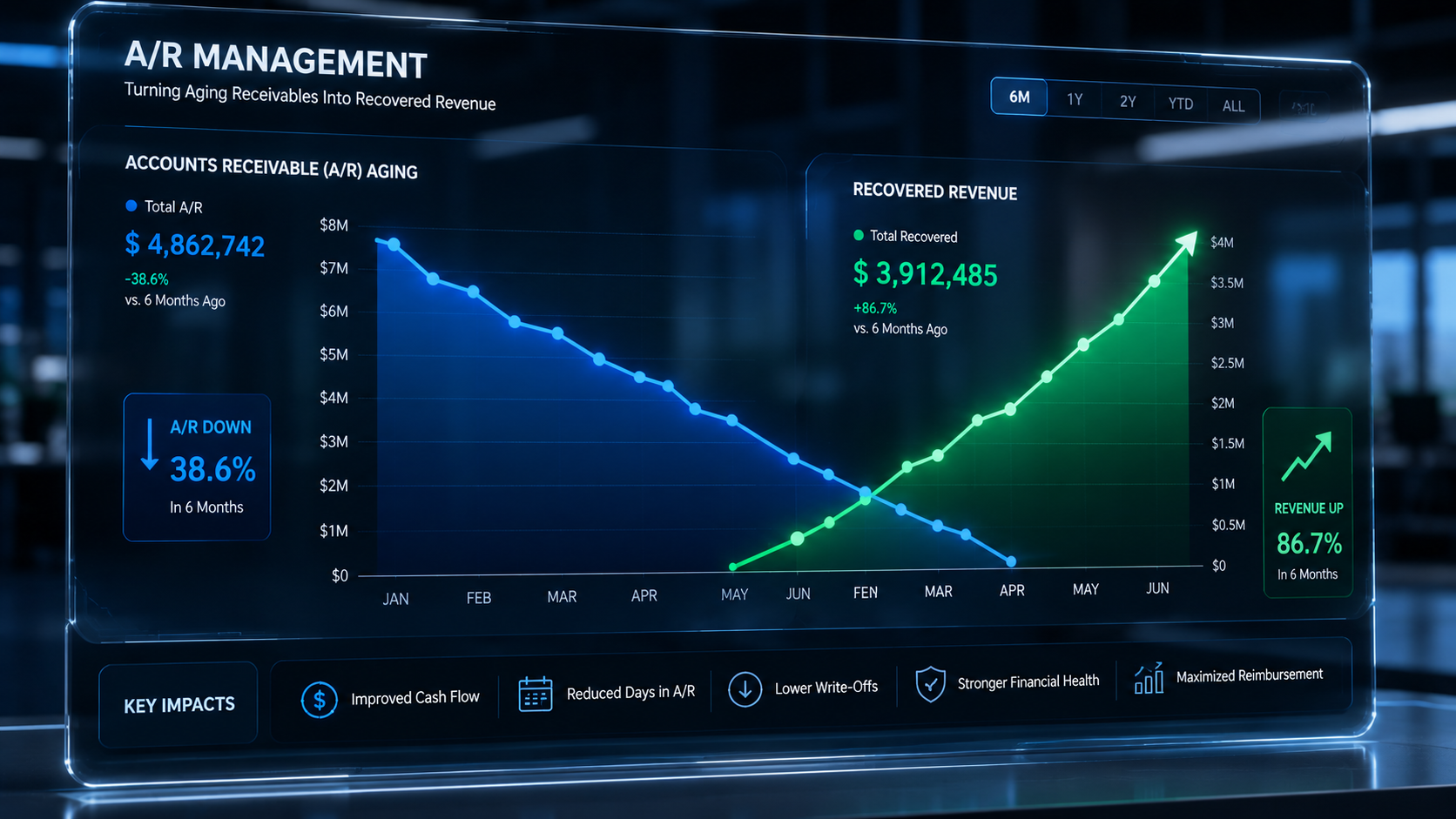
Unlike inventory or real estate, medical A/R is a rapidly depreciating asset. As a claim ages, the likelihood of securing payment diminishes exponentially. This is tracked using an A/R Aging Report, which typically buckets outstanding claims into 30-day increments: 0-30 days, 31-60 days, 61-90 days, 91-120 days, and >120 days.
2. The Anatomy of a Medical Claim Denial
To recover stalled revenue, one must first understand exactly how and why it stalled. When an insurance payer adjudicates a claim and refuses to pay it in full, they issue an Electronic Remittance Advice (ERA) or a paper Explanation of Benefits (EOB).
Within this document, the payer attaches a Claim Adjustment Reason Code (CARC). This code is the payer's justification for withholding your money. Denials generally fall into two broad categories:
- Hard Denials: These are irreversible. For example, if a provider performs a non-emergent procedure that required a Prior Authorization, and that authorization was never obtained, the payer will issue a hard denial. No amount of appealing will recover the funds; it must be written off as a total loss.
- Soft Denials: These are temporary rejections pending correction. Common soft denials include missing modifiers, mismatched patient demographics, or requests for additional medical records to prove medical necessity. If addressed quickly and accurately, soft denials are entirely recoverable.
The core objective of a Denial Management department is to triage the ERAs, isolate the soft denials, and execute a surgical strike to correct and appeal them before the clock runs out.
3. The 5-Step Denial Management Workflow
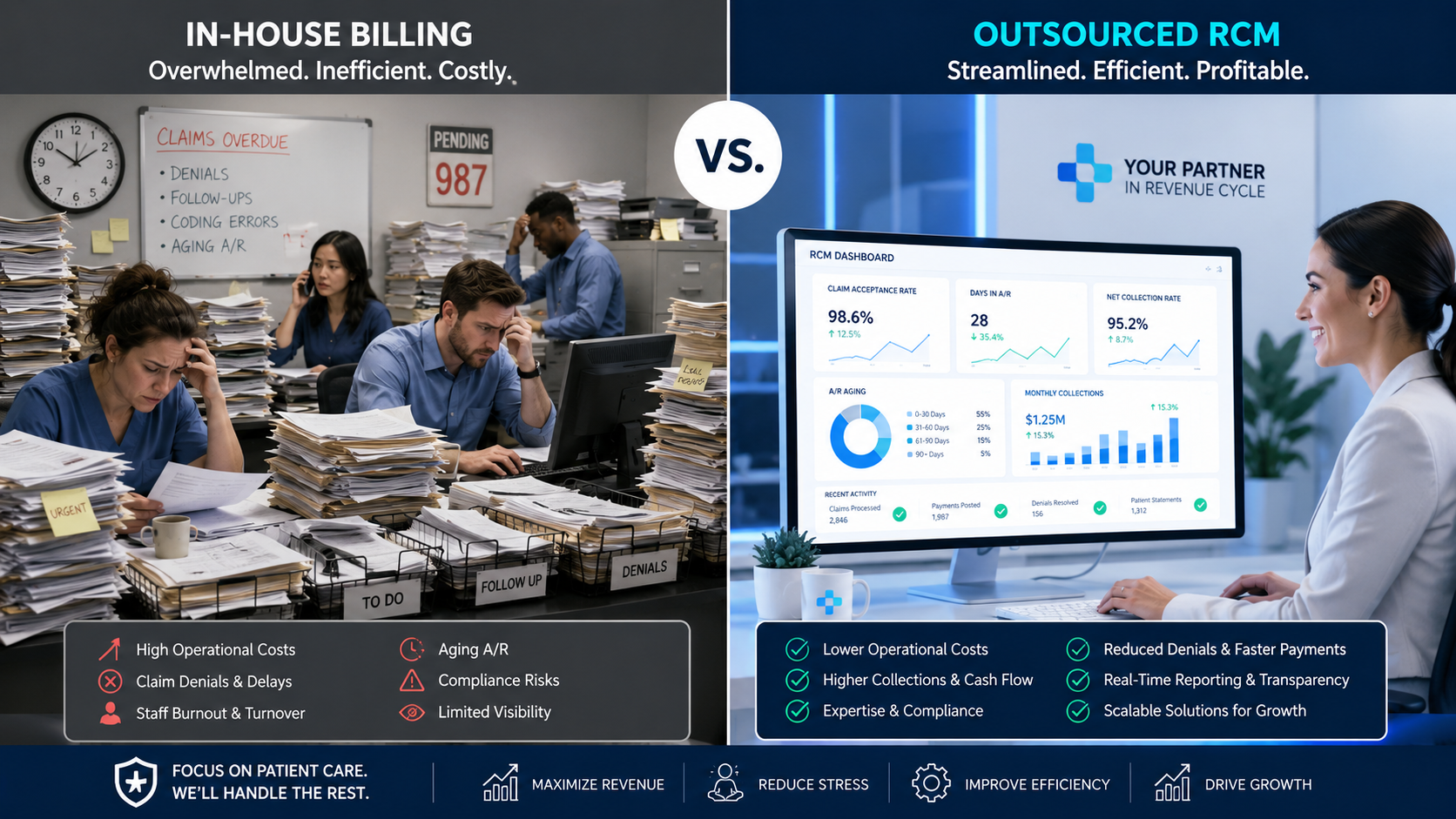
A reactive approach to denials—where billers only work rejected claims when they have "free time"—is a recipe for bankruptcy. Elite healthcare organizations implement a rigorous, unyielding 5-step workflow.
Step 1: Immediate Identification and Triage
The moment an ERA arrives with a zero-dollar payment or a partial payment, it must be flagged. Billers should sort denials not chronologically, but by dollar value and timely filing deadline. A $4,000 surgical denial nearing its 90-day filing limit must be worked before a $75 routine E/M visit denial.
Step 2: Root Cause Investigation
Never simply hit the "resubmit" button in the EMR. A biller or certified coder must investigate the CARC code. If the code is CO-11 (Diagnosis inconsistent with procedure), the coder must open the physician's clinical notes to verify if a more specific ICD-10 code is justified by the documentation.
Step 3: Correction and Documentation Gathering
Once the error is identified, the claim is corrected. If the payer is demanding proof of medical necessity, the RCM team must extract the relevant clinical charts, operative reports, or lab results from the EMR to attach to the appeal.
Step 4: Formal Appeal Submission
Depending on the payer's specific rules, the corrected claim is submitted via a formal appeal process. This may involve submitting a "Corrected Claim" electronically with the proper bill frequency code (e.g., a '7' indicating a replacement of prior claim), or it may require a formal, written appeal letter accompanied by clinical evidence.
Step 5: Relentless Follow-Up
An appeal submitted into the void is a wasted effort. The denial management team must diary the claim and follow up with the payer via phone or web portal every 14 to 21 days until a final adjudication is rendered.
4. Advanced Strategies for Claim Appeals
Writing an appeal letter requires a blend of clinical understanding, coding expertise, and legal fortitude. When drafting an appeal, adhere to the following best practices:
Be Concise and Factual
Payer representatives are evaluating hundreds of appeals a day. Do not write a novel. State the patient's name, the date of service, the claim number, the original denial reason, and precisely why the denial was erroneous based on specific CPT or NCCI guidelines.
Highlight the Clinical Proof
Do not just send a 50-page medical record. Extract the exact page of the operative report or progress note that proves medical necessity, and physically highlight the relevant sentences for the reviewer.
Cite Payer Policy
The strongest appeals use the payer's own rules against them. If you are appealing a bundled service denial, cite the specific National Correct Coding Initiative (NCCI) edit table that proves the use of Modifier 59 was appropriate.
Escalate to Peer-to-Peer
If a high-dollar surgical claim is continually denied for lack of medical necessity by an administrative reviewer, schedule a Peer-to-Peer review where your physician speaks directly to the insurance company's medical director.
5. Liquidating the >90 Day Aging A/R Bucket
If your practice has accumulated a massive backlog of claims older than 90 days, you are in a race against time. Insurance contracts feature Timely Filing Limits—deadlines after which a claim can no longer be appealed or billed. For many commercial payers, this limit is a mere 90 to 120 days. Once that deadline passes, the revenue is legally forfeited.
To liquidate this aging bucket, implement an "A/R SWAT Team" methodology:
- Export and Sort: Export your entire >90 Day A/R report to Excel. Sort it first by Timely Filing Deadline (closest to expiring at the top), and second by Dollar Amount (highest to lowest).
- Write Off the Unrecoverable: Be ruthless. If a $40 claim has passed the timely filing limit and you have no proof of prior timely submission, write it off immediately. Stop wasting labor dollars chasing dead revenue; clear the ledger to focus on salvageable high-dollar claims.
- Batch Payer Calls: Do not call BlueCross for one patient, then Aetna for another. Filter the list by payer. Have a dedicated AR specialist call BlueCross and work through 15 stalled claims in a single, highly efficient phone call.
6. Preventative Analytics: Stopping Denials at the Source
The ultimate goal of denial management is to put the department out of business by preventing denials from occurring in the first place.
This is achieved through Denial Root Cause Analysis. Every month, the RCM director must generate a report of the top 10 denial codes by volume. If 40% of all denials are CO-16 (Demographic Errors), the front desk workflow is fundamentally broken, and retraining is required immediately. If the top denial is CO-4 (Modifier missing), the coding team needs an immediate audit and continuing education regarding NCCI edits.
By using the backend denial data as a feedback loop to train front-end staff and clinicians, practices can continuously drive their Clean Claim Rate upward, starving the A/R aging buckets of new debt.
7. Case Study: Rescuing $850K in Aging A/R for a NY Surgical Center
The Ticking Time Bomb
The Client: A high-volume ambulatory surgical center (ASC) in New York. While their surgical schedule was fully booked, their internal billing team of three was drowning. Their total A/R had swelled to $2.2 million, with an alarming $850,000 sitting in the >120 Day bucket.
The Diagnosis: The in-house staff simply did not have the manpower to submit new surgical claims and simultaneously sit on hold with payers to appeal complex bundling denials. They were prioritizing new claims, allowing hundreds of thousands of dollars in older claims to drift dangerously close to the 180-day timely filing limits.
The Axon Claim Intervention: The ASC partnered with Axon Claim to execute a dedicated A/R Recovery project.
- We deployed a specialized team of 5 A/R recovery experts who exclusively targeted the $850k aging bucket.
- We utilized proprietary software to batch-appeal over 400 claims that had been denied for "lack of medical necessity" by attaching the specific operative reports.
- The Results: Within 60 days, Axon Claim successfully overturned and collected $520,000 of the "lost" revenue before it expired. We subsequently assumed total management of their RCM, ensuring their >90 Day A/R never again exceeded 12% of total receivables.
8. Why A/R Recovery Often Requires Outsourcing
For independent medical practices and specialty groups, achieving elite denial management internally is incredibly difficult. Why? Because the very nature of front-office and back-office clinic work is entirely reactive to the patient sitting in the waiting room.
When the phone is ringing, patients are checking in, and physicians need immediate assistance, the complex, analytical, and tedious task of calling an insurance company to argue over a CO-11 denial is always the first task abandoned.
Outsourcing your Revenue Cycle Management to a dedicated partner like Axon Claim isolates the financial machinery from the clinical chaos. Our AAPC-certified coders and dedicated AR specialists operate in an environment where their only objective is aggressively pursuing your revenue. Furthermore, because our fees are performance-based, we are financially incentivized to fight for every single dollar, regardless of how old or complex the denial may be.
9. Conclusion
In the high-stakes arena of healthcare billing, unworked denials and bloated Accounts Receivable reports are not just administrative headaches—they are existential threats to a practice's survival. Insurance companies rely on provider fatigue; they bank on the fact that overwhelmed in-house billing teams will simply give up on appealing complex denials.
Refusing to surrender your legally earned revenue requires a shift in operational philosophy. By implementing rigid 72-hour appeal workflows, utilizing data analytics to fix front-end errors, and leveraging the relentless pursuit of specialized A/R recovery teams, healthcare providers can permanently close their revenue leaks. Master your denial management, and you secure the financial future of your medical practice.
Axon Claim LLC – A/R Recovery Specialists
We are a premium Revenue Cycle Management partner dedicated to helping healthcare providers across NY, NJ, and the US maximize their revenue. From rescuing legacy Accounts Receivable to AAPC-certified medical coding, we protect your practice's financial health.
Is Your Money Expiring?
Every day a denied claim sits in your A/R, the chance of collection drops. Before timely filing limits expire, let our A/R SWAT team audit your aging reports for free.
Request a Free A/R AuditRecover Lost Revenue Today