Executive Summary
In the high-stakes environment of healthcare Revenue Cycle Management (RCM), insurance verification is the absolute first line of defense. Yet, it remains one of the most chronically neglected workflows in independent medical practices. Many front-desk teams, overwhelmed by patient volume, rely on a dangerous assumption: if the patient has a physical insurance card, they have active coverage. This fallacy directly fuels the rise of CARC CO-27 denials (Expenses incurred after coverage terminated). The financial devastation of treating uninsured or underinsured patients extends far beyond the initial claim rejection; it artificially inflates Accounts Receivable (A/R) aging, squanders administrative labor on futile appeals, and ultimately crystallizes into massive bad-debt write-offs. This comprehensive guide dissects the hidden financial hemorrhage caused by manual verification failures and provides clinical administrators with the technological and operational blueprint to automate 100% of their Eligibility and Benefits (E&B) workflows.
Key Takeaways
- The Illusion of the Card: A physical insurance card only proves that a patient once had coverage. It does not prove the premium was paid this month, nor does it detail current deductible balances.
- The Domino Effect of CO-27 Denials: Providing a $2,000 service to a patient with terminated coverage results in an un-appealable denial. The practice must then attempt to collect 100% of the cost from the patient—a scenario that statistically results in a total loss.
- The Rise of HDHPs: High-Deductible Health Plans have shifted immense financial responsibility to the patient. Without precise eligibility verification, the front desk cannot accurately estimate or collect POS (Point of Service) payments.
- Batch Automation is Mandatory: Manual verification via phone calls or individual portal logins is mathematically impossible for high-volume clinics. Clearinghouse batch verification must be utilized 48 hours prior to the date of service.
- Outsourcing Verification: Because in-house staff are often tied to immediate patient care, elite practices outsource their 48-hour advanced verification to specialized RCM partners to guarantee zero revenue leakage.
Table of Contents
- What is Comprehensive Insurance Verification?
- The True Financial Cost of Verification Failures
- The High-Deductible Health Plan (HDHP) Crisis
- Manual vs. Automated Verification Workflows
- The 48-Hour Advanced Verification Blueprint
- Navigating Patient Communication When Coverage Lapses
- Case Study: Rescuing a New Jersey Gastroenterology Clinic
- Why Top Practices Outsource Eligibility Verification
- Conclusion
1. What is Comprehensive Insurance Verification?
In many clinics, "verifying insurance" simply means a receptionist looks at the patient's card, notes the payer is Aetna, and clicks a checkbox in the EMR. This is not verification; this is data entry.
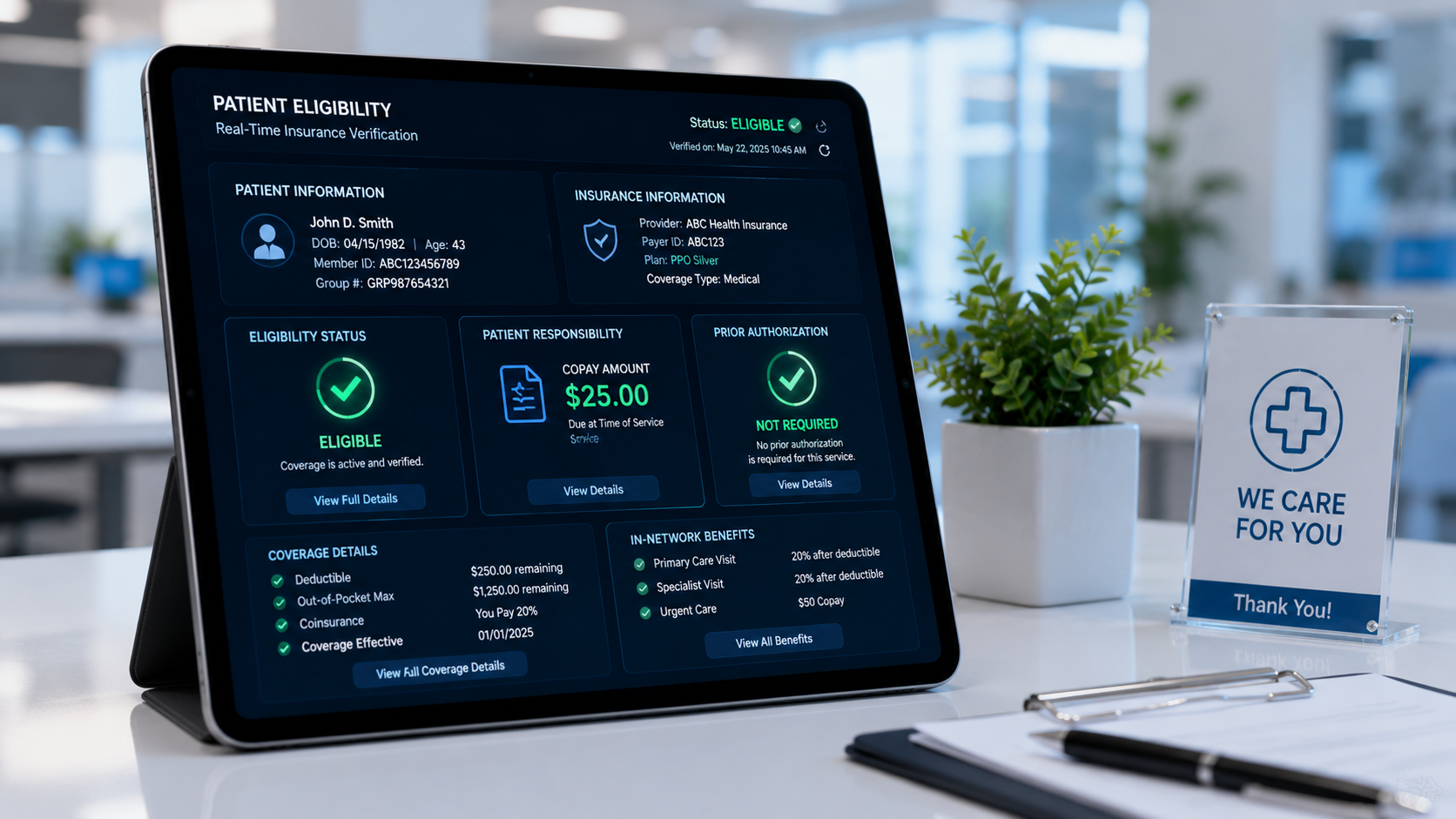
Comprehensive Eligibility and Benefits (E&B) verification is an analytical process that demands real-time data extraction directly from the payer's database. A true verification workflow must confirm five critical data points before the patient is ever allowed into an exam room:
- Active Status: Is the policy currently active for the specific Date of Service (DOS)?
- Coverage Limitations: Is the specific specialist (e.g., Cardiology, Dermatology) covered under the patient's specific plan type (HMO, PPO, EPO)?
- Deductible Status: What is the patient's annual deductible, and precisely how much of it has been met as of today?
- Co-Insurance and Copayments: What is the exact percentage or flat fee the patient is responsible for at the Point-of-Service?
- Coordination of Benefits (COB): Does the patient have a secondary insurance (like Medicare) that dictates a strict billing hierarchy?
Failing to secure any one of these five data points guarantees either a downstream claim denial or a massive patient bad-debt write-off.
2. The True Financial Cost of Verification Failures
When insurance verification is skipped, the financial damage compounds rapidly across the entire revenue cycle.
The CO-27 Denial Trap
The most immediate consequence of poor verification is the CARC CO-27 denial: Expenses incurred after coverage terminated. Patients change jobs, fail to pay COBRA premiums, or age out of their parents' plans constantly. If a provider performs a $1,500 procedure on a patient whose insurance lapsed three days prior, the insurance company owes the provider nothing.
The Administrative Rework Drain
According to the Medical Group Management Association (MGMA), it costs a practice approximately $25 in administrative labor to rework a single denied claim. When a claim is denied for eligibility issues, the back-end biller must call the patient, attempt to track down their new insurance information, update the EMR, and resubmit the claim. If the practice processes 200 eligibility denials a month, that is $5,000 wasted in pure administrative overhead.
Bloated A/R and Bad Debt
When a CO-27 denial hits, the balance must be transferred to patient responsibility. The probability of collecting a $1,500 balance from a patient 45 days after the service was rendered drops below 30%. The claim ages rapidly in the >90 Day Accounts Receivable bucket until the practice is ultimately forced to send it to collections or write it off entirely as bad debt.
3. The High-Deductible Health Plan (HDHP) Crisis
Over the last decade, the healthcare insurance landscape has undergone a seismic shift toward High-Deductible Health Plans (HDHPs). Patients are increasingly responsible for the first $3,000 to $6,000 of their medical care before their insurance covers a single cent.
Accurate, granular eligibility verification is the only mechanism that allows a practice to calculate and demand a deductible deposit at the Point-of-Service (POS). Without it, your practice is effectively operating as an unsecured, zero-interest credit card for your patients.
4. Manual vs. Automated Verification Workflows
How a practice conducts verification dictates their operational efficiency.
The Manual Approach (Obsolete)
Relying on front-desk staff to call insurance companies or log into individual payer web portals for every patient on the schedule. It takes an average of 12 minutes to verify a single patient manually. For a clinic seeing 60 patients a day, this requires 12 hours of labor—a mathematical impossibility for a receptionist handling check-ins.
The Automated Approach (Elite)
Utilizing an integrated clearinghouse connection to send an electronic EDI 270 (Eligibility Request) file for the entire day's schedule simultaneously. The system receives a 271 (Eligibility Response) file instantly, updating the EMR with active statuses, copays, and deductible balances without a single phone call.
5. The 48-Hour Advanced Verification Blueprint
To completely insulate the practice from eligibility-driven revenue loss, clinical administrators must implement the 48-Hour Advanced Verification Workflow.
- T-Minus 48 Hours: The RCM system or billing team runs an automated batch eligibility check for all patients scheduled two days out.
- The Triage: The system highlights exceptions. Any patient returning an "Inactive," "Not Found," or "PCP Mismatch" status is flagged on a highly visible dashboard.
- The Intervention: A dedicated staff member immediately calls the flagged patients. "Mr. Smith, our system shows your BlueCross policy is currently inactive. Do you have updated insurance information we can process before your appointment on Thursday?"
- The Ultimatum: If the patient cannot produce active insurance, they are informed of the practice's self-pay policy. They must agree to pay the estimated cost of the visit out-of-pocket, or the appointment is rescheduled.
This workflow guarantees that by the time the clinic doors open in the morning, 100% of the schedule is financially cleared.
6. Navigating Patient Communication When Coverage Lapses
The hardest part of the 48-Hour Rule is training staff to have uncomfortable financial conversations. Front desk personnel must be equipped with firm, professional scripts.
The Front-Desk Scripting Guide
Scenario: HMO PCP Mismatch
"Mrs. Davis, we verified your insurance today, but your HMO plan still lists Dr. Miller as your Primary Care Physician. To see our specialist tomorrow, you must call your insurance company today and update your PCP to our doctor. If this isn't updated by tomorrow, your insurance will deny the claim and you will be responsible for the full $250 visit cost."
Scenario: High Unmet Deductible
"Mr. Johnson, our verification shows you still have $2,000 remaining on your annual deductible. Our policy requires a $150 deposit toward that deductible before your procedure today. We also require a credit card on file to cover the remaining balance once your insurance finalizes the claim."
7. Case Study: Rescuing a New Jersey Gastroenterology Clinic
The E&B Overhaul
The Client: A bustling gastroenterology clinic in New Jersey seeing over 100 patients daily. Their patient bad-debt write-offs had exceeded $25,000 a month, and their back-end billing team was overwhelmed with CO-27 (coverage terminated) denials.
The Diagnosis: The front desk was entirely reactive. They were scanning insurance cards but not verifying them through the clearinghouse due to "lack of time." They were routinely treating patients whose Medicaid had lapsed or whose commercial insurance had changed at the start of the new year.
The Axon Claim Intervention: The clinic outsourced their entire front-end verification process to Axon Claim.
- We instituted automated batch 270/271 EDI checks 48 hours prior to every DOS.
- Our off-site team managed all the "exception" calls, contacting patients with lapsed coverage to secure updated policies before they arrived.
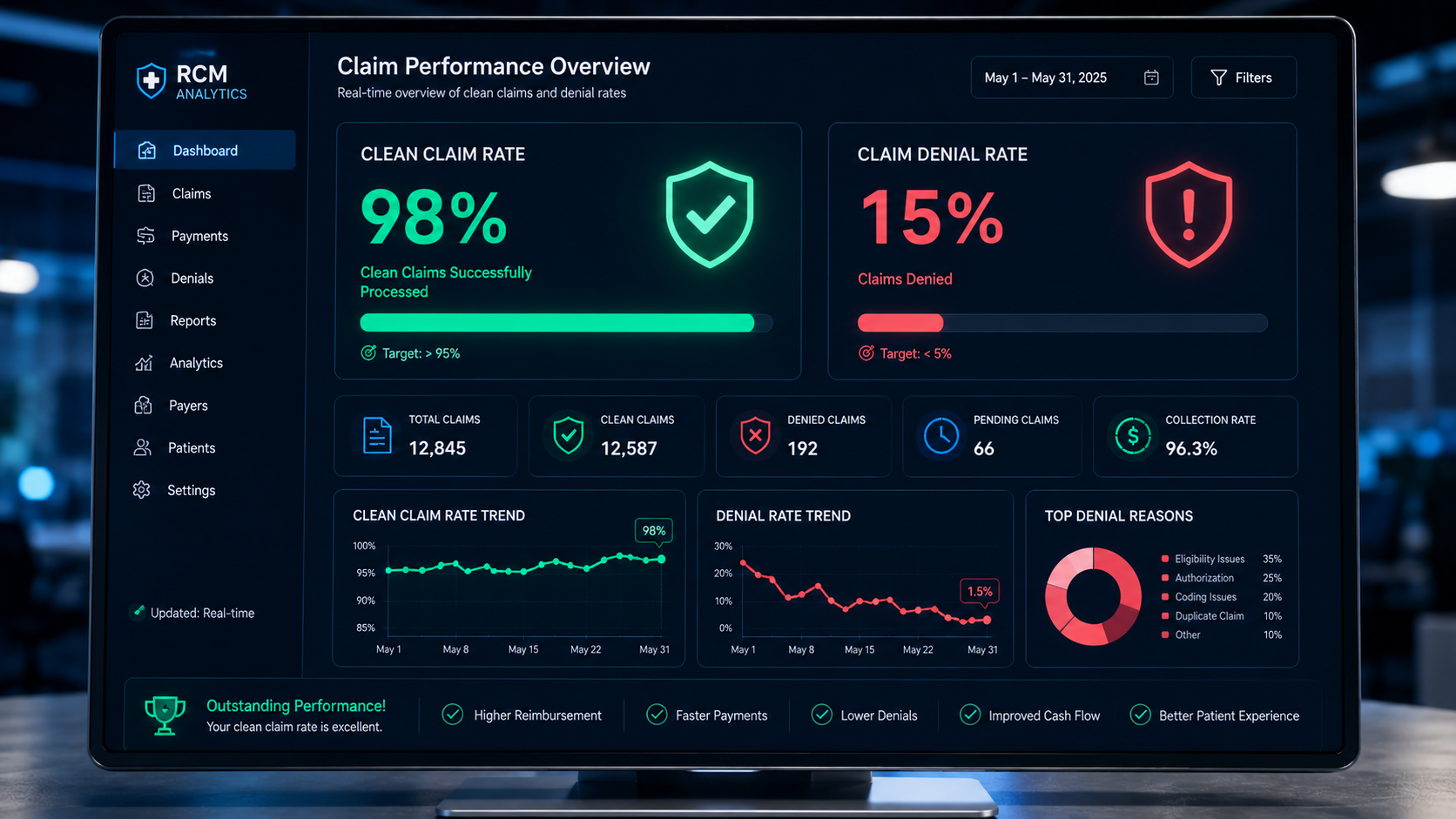
- The Results: Within 60 days, CO-27 denials dropped by 94%. Because the front desk was provided with exact unmet deductible amounts, POS collections increased by $18,000 a month. The back-end billing team, freed from eligibility rework, was able to focus entirely on high-dollar surgical appeals.
8. Why Top Practices Outsource Eligibility Verification
Expecting an in-house receptionist to greet patients, answer five phone lines, schedule follow-ups, and meticulously verify complex insurance benefits is an operational failure. It places the most critical financial checkpoint in the hands of the most distracted employee.
To eliminate this bottleneck, independent practices increasingly rely on outsourced Revenue Cycle Management partners like Axon Claim. By removing the eligibility burden from the clinic's physical front desk, the practice ensures that verification is performed with analytical precision by dedicated experts. This insulates the practice from bad debt, drastically reduces downstream denials, and allows the in-house staff to focus entirely on delivering an exceptional patient experience.
9. Conclusion
Insurance verification is not merely an administrative checkbox; it is the financial foundation of the entire medical encounter. Treating a patient without absolute certainty of their active coverage and deductible status is a gamble that modern medical practices simply cannot afford to take.
By shifting from a reactive, manual front-desk process to a proactive, automated 48-Hour Advanced Verification workflow, healthcare organizations can definitively stop revenue leakage before the patient ever sees the physician. Master your eligibility workflows, and you will secure the cash flow your practice deserves.
Axon Claim LLC – Front-End RCM Specialists
We are a premier Revenue Cycle Management partner dedicated to helping healthcare providers across NY, NJ, and the US maximize their revenue. From automated eligibility verification to aggressive back-end AR recovery, we protect your practice's financial health.
Stop Treating Uninsured Patients for Free.
Manual verification is costing your practice thousands in bad debt. Let our RCM experts automate your eligibility workflows and eliminate CO-27 denials forever.
Request a Workflow AuditSecure Your Revenue Upfront