Executive Summary
In Revenue Cycle Management (RCM), an undeniable operational truth exists: "Garbage in, garbage out." If the front-end of the revenue cycle—patient scheduling, registration, eligibility verification, and prior authorization—is flawed, the back-end billing team cannot perform miracles. A misspelled name or an unverified inactive policy at the front desk will trigger an automated denial at the clearinghouse, adding weeks to the Accounts Receivable (A/R) lifecycle and driving up administrative costs. Furthermore, with the rise of High-Deductible Health Plans (HDHPs), patient financial responsibility now accounts for up to 30% of a practice's total revenue. Waiting to collect this money on the back-end via paper statements is mathematically inefficient, often resulting in massive bad debt write-offs. This comprehensive guide dissects the critical components of the front-end revenue cycle, providing practice administrators with the exact technological workflows and staff training protocols required to secure revenue before the clinical encounter begins.
Key Takeaways
- Prevention over Appeals: Over 40% of all medical claim denials originate from simple front-end demographic and eligibility errors. Fixing these errors at the point of registration saves the practice thousands in rework costs.
- The 48-Hour Eligibility Rule: Relying on photocopied insurance cards from last year is a guaranteed revenue leak. Electronic Eligibility and Benefits (E&B) must be verified 48 hours prior to every scheduled appointment.
- Prior Authorization is Paramount: Failure to secure a payer-mandated prior authorization before rendering a service results in an irreversible "hard denial." The patient cannot be billed, and the revenue is permanently lost.
- Point-of-Service (POS) Collections: The probability of collecting a patient's balance drops to 40% once they walk out the clinic doors. Collecting copays, deductibles, and past-due balances at the front desk is mandatory for cash flow survival.
- Technology is Not a Substitute for Training: While automated EMR verification tools are vital, front-desk staff must be rigorously trained in financial communication, learning how to ask for money professionally and handle patient objections.
Table of Contents
- Defining the Front-End Revenue Cycle
- The Cost of Demographic Errors (CO-16)
- Mastering Electronic Eligibility and Benefits (E&B)
- The Prior Authorization Bottleneck
- Maximizing Point-of-Service (POS) Collections
- Financial Communication: Training the Front Desk
- Case Study: Transforming a New Jersey Specialty Clinic's Cash Flow
- Action Plan: 5 Steps to Front-End Optimization
- Conclusion
1. Defining the Front-End Revenue Cycle
The Revenue Cycle is traditionally divided into three phases: Front-End (Patient-Facing), Middle (Clinical/Coding), and Back-End (Billing/Collections). The Front-End encapsulates every single action taken from the moment a patient requests an appointment until the moment they are escorted into the exam room.
The critical steps of the front-end cycle include:
- Scheduling & Pre-Registration: Gathering preliminary demographic and insurance data before the patient arrives.
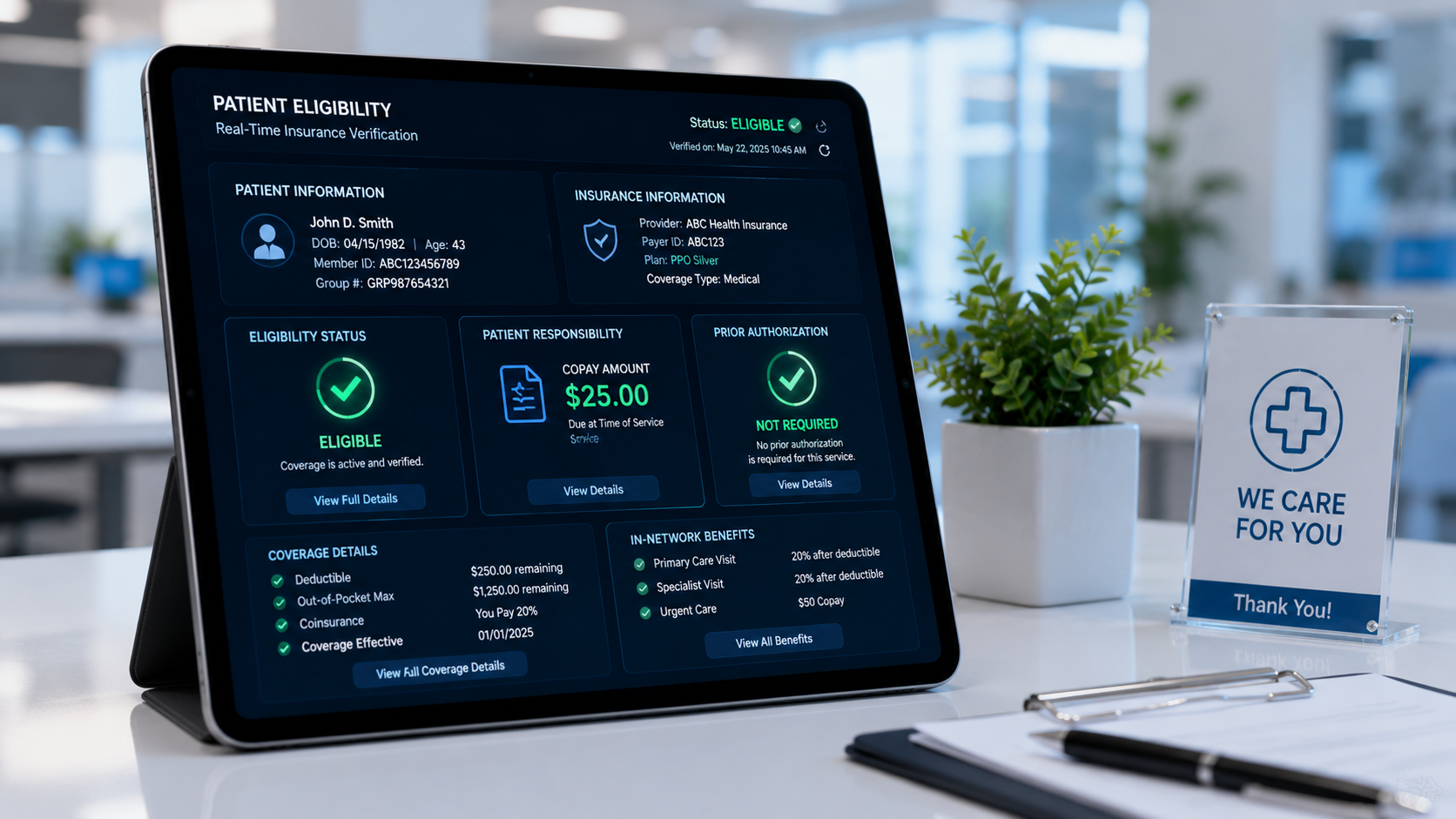
- Eligibility & Benefits Verification: Confirming that the patient's insurance policy is active and determining their specific copay, deductible, and co-insurance responsibilities.
- Prior Authorization: Securing formal approval from the insurance payer for high-cost procedures or specialty referrals.
- Patient Check-In & POS Collection: Physically scanning ID and insurance cards, having the patient sign financial consent forms, and collecting the patient's financial responsibility upfront.
When these steps are executed flawlessly, the back-end billing team receives a "clean" encounter that easily passes clearinghouse scrubs and payer adjudication engines, resulting in rapid reimbursement.
2. The Cost of Demographic Errors (CO-16)
It is the most frustrating denial in the medical billing industry: CARC CO-16 (Claim/service lacks information or has submission/billing error). This denial occurs when the data on the claim does not perfectly match the data in the payer's system.
A transposed digit in a date of birth, a missing suffix (Jr./Sr.), an incorrect subscriber ID, or submitting the claim to the wrong payer ID will trigger an instant rejection. While these errors are technically "soft denials" that can be corrected and resubmitted, the administrative cost of the rework is staggering.
The Solution: Implement digital patient intake via secure mobile portals. When patients type their own names, addresses, and policy numbers on their smartphones prior to arrival, demographic error rates plummet by over 80%. Furthermore, implement a strict "Card Scan" policy requiring a physical scan of the front and back of the insurance card at every visit, regardless of whether the patient was seen last week.
3. Mastering Electronic Eligibility and Benefits (E&B)
Verifying that a patient "has insurance" is no longer sufficient. An insurance card is merely a piece of plastic; it does not indicate whether the premium was paid this month, whether the specific service is a covered benefit, or whether the patient's $5,000 deductible has been met.
Failure to verify active coverage results in a CO-27 denial (Expenses incurred after coverage terminated), leaving the practice holding the bag to collect 100% of the cost from an uninsured patient.
The 48-Hour Batch Verification Rule
Elite practices do not verify insurance while the patient is standing at the desk. They utilize automated clearinghouse technology to run a "batch" eligibility check on the entire schedule 48 hours in advance. This process returns an electronic 271 response file detailing:
- Active/Inactive policy status
- Remaining deductible amounts
- Specific specialist copays
- Out-of-pocket maximums
- Coordination of Benefits (identifying primary vs. secondary insurance)
Any patient flagged with "Inactive" status is immediately called by the front desk to resolve the issue before they consume a valuable slot on the physician's schedule.
4. The Prior Authorization Bottleneck
Insurance payers utilize Prior Authorization (Pre-Certification) to control costs, requiring physicians to prove the medical necessity of a high-cost procedure, advanced imaging (MRI/CT), or specialty medication before it is provided.
If a service requires authorization and the front desk fails to obtain the specific auth number, the payer will issue a CO-197 denial. This is a "hard denial." The claim cannot be appealed, and you are legally prohibited from billing the patient. The practice must write off the entire cost of the procedure.
Optimizing the Authorization Workflow
1. Maintain Payer Auth Matrixes
Rules change constantly. Maintain a shared, digital matrix that explicitly lists which specific CPT codes require prior authorization for your top 10 commercial payers and Medicare Advantage plans.
2. Implement EMR Hard Stops
Configure your practice management system so that a scheduler physically cannot book an MRI or surgical procedure unless an authorization number is entered into the designated required field.
3. Centralize the Function
Do not expect the person answering phones and checking in patients to also manage complex clinical peer-to-peer authorization calls. Dedicate a specific, clinically trained staff member to manage all auths.
4. Verify Hospital vs. Office
Ensure the authorization is obtained for the exact Place of Service (POS). An auth for an injection in the ASC (POS 24) will be denied if the injection is performed in the clinic (POS 11).
5. Maximizing Point-of-Service (POS) Collections
With the proliferation of High-Deductible Health Plans (HDHPs), patients are now frequently responsible for the first $3,000 to $5,000 of their medical care. Patient responsibility is no longer a tiny fraction of practice revenue; it is often the margin between profitability and bankruptcy.
The Golden Rule of Patient Collections: The probability of collecting a balance drops to roughly 40% once the patient leaves the office. If you rely on mailing paper statements 45 days after the date of service, you are guaranteeing massive bad debt write-offs.
A highly optimized front desk collects the following at the Point-of-Service:
- The Copay: Must be collected before the patient sits in the waiting room. "No copay, no see."
- The Estimated Deductible/Co-Insurance: Utilizing the real-time E&B data, the front desk must collect a deposit toward the patient's known unmet deductible.
- Past Due Balances: The EMR must flash an alert if the patient has an outstanding balance from a previous visit. The front desk must ask for this balance before clearing the patient for their current appointment.
- Credit Card on File (CCOF): Have patients sign an authorization to keep a secure, encrypted credit card token on file to automatically charge remaining balances up to a specific limit (e.g., $150) once the insurance claim adjudicates.
6. Financial Communication: Training the Front Desk
Implementing strict POS collection policies will fail if your front desk staff lacks the confidence to communicate those policies to patients. Many receptionists feel uncomfortable asking sick or injured patients for money, leading to hesitant language.
Front-desk staff must be rigorously trained in Financial Communication Scripts to ensure consistency and professionalism.
The Wrong vs. Right Way to Ask for Money
The Weak Approach (Invites Excuses)
"Would you like to pay your $40 copay today, or should we just bill you for it later?"
Why it fails: It gives the patient an easy out. 90% of patients will choose to be billed later, destroying your cash flow and driving up statement mailing costs.
The Authoritative Approach (Assumes Payment)
"Mr. Smith, your insurance dictates a $40 specialist copay for today's visit, and you also have a $35 balance from your lab work last month. Your total today is $75. How would you like to pay for that, Visa or Mastercard?"
Why it works: It firmly establishes that payment is expected immediately, blames the insurance company for the copay requirement, and offers a choice of payment method, not a choice of whether to pay.
7. Case Study: Transforming a New Jersey Specialty Clinic's Cash Flow
The POS Collection Overhaul
The Client: A high-volume dermatology clinic in northern New Jersey. The clinic was seeing 80 patients a day, but their patient A/R was skyrocketing. They were mailing over 1,500 paper statements a month and writing off $15,000 monthly in uncollected patient debt.
The Diagnosis: An Axon Claim operational audit revealed that the front desk was only collecting copays 40% of the time. They were never asking for past-due balances, and they had no process for estimating or collecting unmet deductibles for in-office procedures.
The Axon Claim Intervention: We implemented a complete front-end overhaul.
- We deployed the "48-Hour Eligibility Rule," ensuring the front desk knew exactly how much deductible remained for every patient on the schedule.
- We instituted a "Credit Card on File" (CCOF) policy for all cosmetic and surgical procedures.
- We conducted a 2-day training seminar, role-playing financial communication scripts with the reception team to build their confidence.
- The Results: Within 90 days, POS collections surged by 310%. The clinic reduced their statement mailing volume by 60%, drastically cutting administrative overhead, and virtually eliminated their monthly patient bad-debt write-offs.
8. Action Plan: 5 Steps to Front-End Optimization
To eliminate front-end denials and maximize POS cash flow, implement these five non-negotiable operational standards immediately:
- Mandate Digital Intake: Transition all new patient registration forms to a secure, HIPAA-compliant digital portal to eradicate manual data-entry typos.
- Enforce the 48-Hour E&B Rule: Run batch eligibility checks two days in advance. Never allow a patient with an inactive policy to sit in the waiting room without first signing a self-pay agreement.
- Centralize Prior Authorizations: Remove the authorization burden from the general front desk. Assign this task to a dedicated specialist or an outsourced RCM partner who understands peer-to-peer clinical requirements.
- Implement Daily POS Targets: Track the front desk's collection rate daily. If 40 patients with a $30 copay were seen, the POS collection report must show $1,200. Hold the staff accountable for the delta.
- Require Credit Cards on File: Adopt modern retail practices. Require patients to authorize a secure card token to cover remaining co-insurance balances post-adjudication, eliminating the need to chase them with paper statements.
9. Conclusion
In modern medical billing, the battle for reimbursement is frequently won or lost at the front desk. Relying entirely on back-end billers to fix demographic errors, appeal retroactive authorization denials, and chase patients for deductible payments is a highly inefficient, costly strategy.
By empowering your front-desk staff with advanced eligibility technology, rigorous financial communication training, and strict Point-of-Service collection protocols, you transform your reception area from an administrative bottleneck into a powerful revenue-generating engine. Optimize your front-end, and you will fundamentally accelerate the financial prosperity of your entire organization.
Axon Claim LLC – Front-End Operations Experts
We are a premier Revenue Cycle Management partner dedicated to helping healthcare providers across NY, NJ, and the US maximize their revenue. From front-desk workflow consulting to full-scale RCM outsourcing, we protect your practice's financial health.
Is Your Front Desk Costing You Revenue?
Missed copays and authorization denials destroy cash flow. Let our RCM consultants audit your front-end workflows to identify exactly where your revenue is leaking.
Request a Workflow AuditBoost POS Collections Today